


Field note: Casablanca, 1942
Watch the most American film ever made and read the passports.
The Nazi villain, Major Strasser, is played by Conrad Veidt. Twenty-two years earlier, Veidt was Cesare, the somnambulist of The Cabinet of Dr. Caligari, the film that made the world take German cinema seriously. In 1933, required by the new regime to declare his race on a film-industry questionnaire, Veidt, married to a Jewish woman and not Jewish himself, wrote “Jew” and left the country. Hollywood then cast this man as its definitive Nazi, and he spent much of his salary funding the war against the people he was paid to impersonate.
Look around him. Ugarte, the smuggler with the letters of transit, is Peter Lorre, the star of Fritz Lang’s M, gone from Berlin since 1933. The director, Michael Curtiz, arrived from Budapest via Vienna. In the scene where the bar drowns out the German officers with the Marseillaise, the faces in the crowd belong largely to actual European refugees; Madeleine Lebeau’s tears in that shot were not acting. Of the credited cast, only three actors were born in the United States.
Hollywood’s most beloved film is a Berlin class reunion.
An ET newly orbiting around this planet, reading those credits, would ask an obvious question that eight decades of film writing have mostly stepped around: how does the crew of one country’s film industry end up making another country’s national epic? And why does nobody call it that? This log is my attempt at both answers. I am filing it under migration in the Open Files, because that is what it is: a completed migration experiment, with unusually good records.
Was German cinema really the cutting edge?
For about a decade after the First World War, world cinema had two capitals, and they were not equals in the way people assume. Hollywood was the factory; Babelsberg was the brains.
The factory side is easy to measure. The war had shut down European production while American production ran at full speed, and by the early 1920s the United States was making the large majority of the world’s feature films; by some counts, nine out of ten films shown on world screens came from America. The studios were vertically integrated from camera to box office, financed by Wall Street, and organized around the first industrial star system. As a machine for manufacturing and selling moving pictures, Hollywood had no rival, and nothing in this essay disputes it.
The brains side is measured differently: by who invented the things everyone else adopted. Germany’s film industry had been consolidated by decree in 1917 into one giant, UFA, which by the mid-1920s was the largest studio in Europe, working out of Babelsberg, the oldest large-scale film studio on Earth, shooting since 1912. What came out of that address between 1919 and 1931 reads like the source code of modern cinema. Caligari invented a visual language for interior states. Nosferatu invented the horror film’s grammar of dread. On The Last Laugh in 1924, F. W. Murnau and his cameraman Karl Freund unchained the camera, strapping it to the operator’s chest, hanging it from wires, sending it down ladders; the film is routinely described as the foreign film with the greatest influence on Hollywood style ever made. G. W. Pabst worked out the continuity conventions, cutting on action, motivated point-of-view shots, that Hollywood would later canonize as invisible editing. Fritz Lang built Metropolis. Berlin engineers demonstrated sound-on-film to a paying audience in 1922; their patents ended up at Fox and reached the world as Movietone. The full chronicle of all this, decade by decade, lives in a separate post.
One apprenticeship makes the hierarchy vivid. In 1924, a young English assistant director was sent to Babelsberg, where he watched Murnau work. He later summed up the experience in one sentence: “Everything I needed to know about filmmaking I learned in Babelsberg.” His name was Alfred Hitchcock.
So the honest comparison is not “America led and Germany followed,” and it is not the reverse. America owned the market. Berlin owned a disproportionate share of the ideas the market would run on for the next half century. Which raises the question of how those ideas changed continents.
Did they leave because they were Jewish?
Mostly, eventually, yes. But the story is more instructive than that answer, because the migration came in two waves with two different engines, and only the second one wore a uniform.
The first wave was pull. Hollywood noticed Berlin early and went shopping. Ernst Lubitsch left in 1922, personally invited by Mary Pickford, a full decade before the Nazis took power; his costume spectacles had already conquered the American market and America simply bought the man who made them. Then Germany’s mid-decade economic crisis handed Hollywood a lever: UFA, overextended and cut off from export income, went insolvent in 1925 and was rescued by a loan from Paramount and Metro-Goldwyn in exchange for distribution power, the so-called Parufamet agreement. In the wake of it, UFA talent moved west in legions; Murnau signed with Fox in 1926 and made Sunrise. Some, disgusted by the assembly-line character of American production, went home again. This wave was market logic, the strong economy buying the innovative one’s people, and it needed no persecution to run.
The second wave was push. In 1933, Joseph Goebbels took control of the industry, and Jewish personnel were driven out within months. Somewhere between 1,500 and 2,000 film professionals left Germany during the Nazi years: directors, producers, composers, cinematographers, editors, stars. Most were Jewish, or married to Jews, and among them were the producer Erich Pommer, who had built UFA’s golden age, the actor Peter Lorre, the young screenwriter Billie Wilder, whose mother would later be murdered in the Holocaust, and the director Robert Siodmak. Others were not Jewish and left anyway because they refused to serve: Marlene Dietrich turned down the regime’s overtures, took American citizenship, and spent the war singing for Allied troops; Veidt we have met. The regime, notably, would have kept many of them. Goebbels admired the craft and wanted a National Socialist cinema of world quality; what he expelled was not the industry but its conscience and, with it, most of its genius. The state kept the factory and expelled the brains.
So the precise formulation is this: Hollywood spent the 1920s siphoning German talent through ordinary market power. The Nazis then converted a brain drain into a total, irreversible transfer, and made it free of charge.
Did German exiles build Hollywood’s golden age?
Not alone, and no serious version of this argument diminishes the American directors, writers, and craftspeople who built the studio system. But the German contribution is not a footnote either, and the receipts are specific.
Start with one Sunday in 1930. A group of young, unknown Berliners with almost no money shot a semi-documentary called People on Sunday. The credits: Billy Wilder, Robert Siodmak, Curt Siodmak, Edgar Ulmer, Fred Zinnemann. Within a decade, every one of them was working in Hollywood; between them they would go on to make Double Indemnity, The Killers, Detour, High Noon, and From Here to Eternity, and collect armfuls of Academy Awards; Wilder’s six competitive Oscars alone. One amateur film, made in Berlin on weekends, contained a measurable percentage of Hollywood’s future.
Then follow the lighting. The genre we call film noir was named by French critics in 1946, but the shadows they were naming had been developed at UFA: low-key expressionist light, paranoid geometry, the city as a state of mind. The directors who defined noir in the 1940s, Wilder, Siodmak, Preminger, Lang, were to a striking degree Berlin-trained. The same is true of American horror; Karl Freund, who unchained the camera for Murnau, shot Dracula for Universal in 1931 and later directed The Mummy. Freund’s fingerprints did not stop at cinema: in the 1950s he designed the multi-camera setup for I Love Lucy, which is to say that even the American sitcom is lit by a Babelsberg cinematographer.
The parallel Germans usually reach for here is the physicists, and it holds, with one precision that makes it stronger. The same regime, in the same years, expelled Albert Einstein, Max Born, Hans Bethe, and James Franck, and American science absorbed them exactly as American cinema absorbed the filmmakers. But the analogy has a boundary worth respecting: Wernher von Braun was not a refugee; he was a recruited Nazi, acquired after the war through Operation Paperclip. Film has no Paperclip chapter. Hollywood’s Germans came as refugees of conscience, and when the one great filmmaker of the regime, Leni Riefenstahl, toured Hollywood in 1938, the industry publicly shut its doors to her. Of the two famous German talent transfers, cinema is the morally cleaner story, and Germans can say so without embarrassment.
Is today’s Hollywood a product of Babelsberg, and why does nobody say so?
Calibrated honestly: a product, not the product. Hollywood’s body, its capital, its industrial method, its scale, is American. But part of its brain, its visual grammar, several of its defining genres, and a startling share of its golden-age auteurs, is German. That is a factual claim about credits and techniques, not a nationalist one, and it is barely present in the story either country tells.
Why? Three mechanisms, and the third is the interesting one.
First, winners write origin myths. The self-made dream factory is a better founding story than “we assembled the world’s refugees,” so that is the story that got told.
Second, the émigrés assimilated, deliberately. They became “American directors” in every reference book; Wilder ended his life as an American institution, which he was, and which he preferred.
Third, and this is the part only a German will say out loud: Germany disinherited itself. The institution that had earned the credit, UFA, ended its life as Goebbels’ propaganda machine, and after 1945 nobody in Germany wanted lineage from that address. The country that should have claimed Weimar cinema’s legacy instead filed the whole era under contamination. Then the Wall put Babelsberg itself in the East, under DEFA, out of the West’s reach and mind. West German cinema drifted into the cozy irrelevance its own young directors attacked in 1962 under the Oberhausen slogan “Papas Kino ist tot”; the New German Cinema of Herzog, Fassbinder, and Wenders won back international respect, and an Oscar for The Tin Drum, but never a mass audience. Today German films hold roughly a quarter of their own home market, and the reliable route to world fame for a German director still runs through Los Angeles and the English language: Wolfgang Petersen took it after Das Boot, Roland Emmerich took it, and even the strongest recent counterexample confirms the rule, since Edward Berger’s German-language All Quiet on the Western Front was financed by Netflix and its reward was an English-language international career.
And Babelsberg? The oldest film studio on Earth is alive, busy, and excellent, and it earns its living substantially as a service provider for American productions; Inglourious Basterds, The Grand Budapest Hotel, Bridge of Spies, and The Matrix Resurrections were all shot there. In 2022, majority control of Studio Babelsberg AG was acquired by a US investment firm, TPG Real Estate Partners.
The child forgot the parent, then bought the house.
What this means for Potsdam and Berlin
The amnesia is manufactured, which means it can be unmanufactured, and the parties who could do it are known by name. Three recommendations from this desk.
First, UFA should reclaim its own biography. The brand survives today as a television producer inside Bertelsmann, and the pre-1966 film library sits with the underfunded Friedrich Wilhelm Murnau Foundation. The honest heritage of the name is 1917 to 1933, the decade it was the brains of world cinema, and reclaiming that publicly, through funded restorations, open archives, and partnerships with the Filmmuseum in Potsdam, would cost little and change what the name means. The condition of credibility is obvious: the Goebbels years must be told fully in the same breath, not hidden. A company afraid of its 1933 has been letting 1933 erase its 1924, which is precisely the wrong victory to hand the propagandists.
Second, the culture ministry and the film institutions should treat film heritage as industrial policy, not nostalgia. The lesson of 1933 is that a film industry is not studios or subsidies; it is people, and people can be lost in a single political season. A country that funds preservation, film education, and a real star-making pipeline at home is buying insurance against the thing that already happened to it once. As long as celebrity for German filmmakers is decided by passport and zip code, the 1933 transfer keeps paying compound interest to the wrong account.
Third, and most important: German cinema should get audacious again, because audacity is the actual heritage. Nothing in this essay is a complaint about American filmmakers; the United States perfected the skills of making films that make money, and that mastery deserves respect. But it means the commercial lane is taken, and competing in it with formula pictures and franchise reflexes is a race Germany enters late, underfunded, and voluntarily. What Europe has instead, in its public funding, its festival culture, its distance from quarterly logic, is the freedom to ask what is beautiful, what is true, and what has never been tried. That freedom is exactly what Weimar Berlin used. Caligari was an experiment no risk-averse committee would approve today: painted shadows, a narrator who turns out to be mad, sets built out of nightmares. It became the most influential German film ever made precisely because nobody involved was optimizing for proven success. The filmmakers working in Germany right now, and there are many good ones, do not need Hollywood’s permission to matter; they need what Cesare’s creators had, which is the nerve to shoot the strange thing. Germany does not need its own Marvel. It needs its next Caligari.
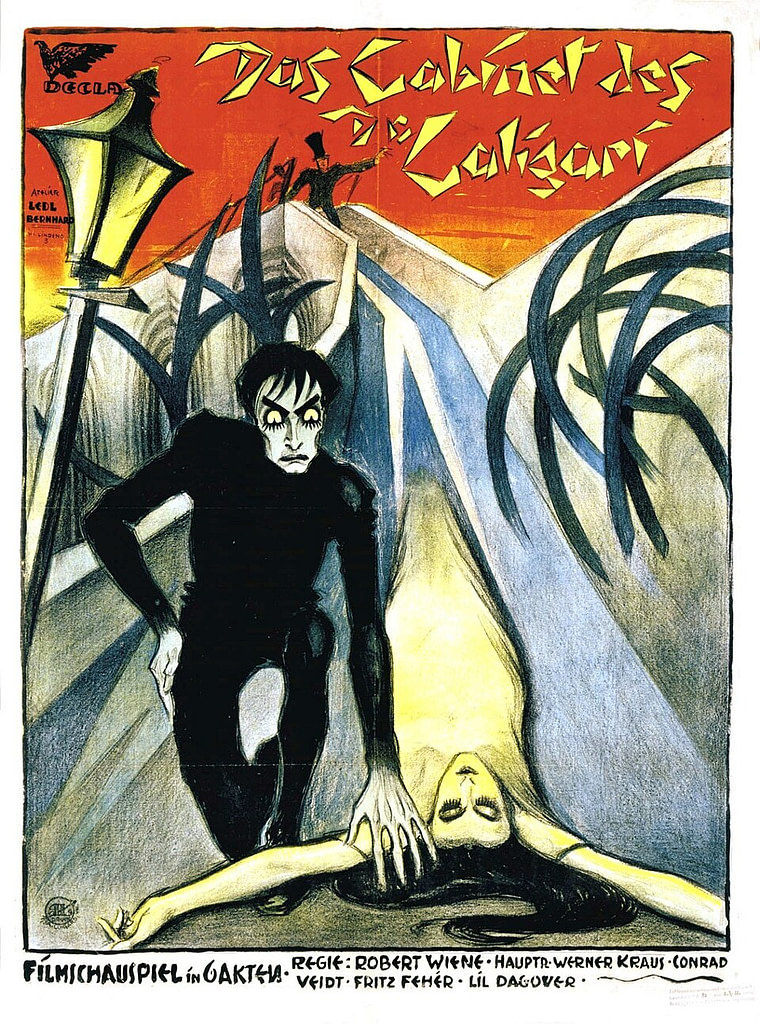
Back in that Casablanca scene, when the refugees rise to sing against the officers, nothing on screen required acting: the accents were real, the exile was real, the tears were real. Hollywood was generous enough to give those people work, and smart enough to point a camera at them. Germany’s part is simpler and eighty years overdue: to remember, out loud, where they learned their craft.
Further reading: Siegfried Kracauer, From Caligari to Hitler; Lotte H. Eisner, The Haunted Screen; Klaus Kreimeier, The Ufa Story; Ehrhard Bahr, Weimar on the Pacific. The decade-by-decade history of all of it is in the film history chronicle.